Tiếng Việt
In the specialized field of aquafeed production, changing to small die sizes (micro-pellet) from 0.5 – 1.5mm, presents significant technical challenges. A minor oversight in operational protocol can lead to die failure, increasing spare part expenditures and causing expensive production downtime.
Base on a real-world technical support case handled by Tien Phat Mechanical, we have performed a Root Cause Analysis (RCA) to identify why dies break during small-size production and how to prevent it.
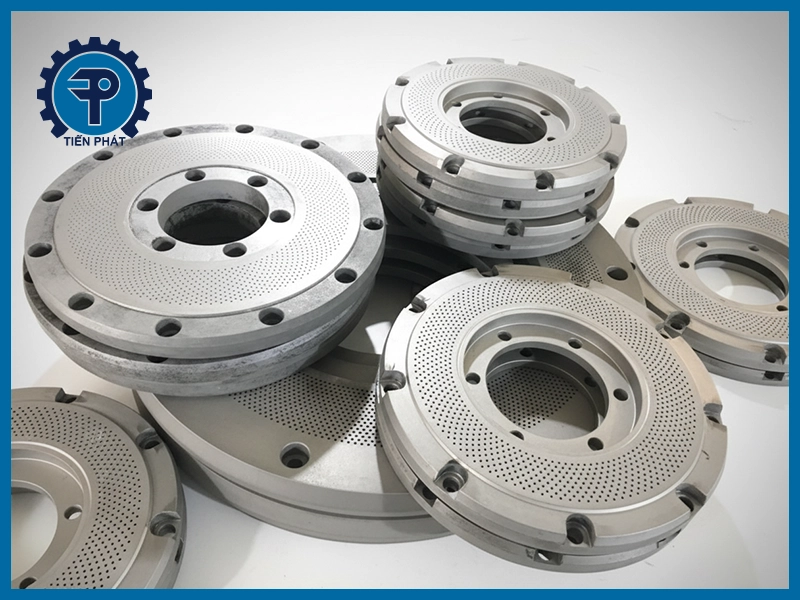
Case Analysis
Our customer reported the consecutive breakage of two extrusion dies (1.2mm and 1.5mm) along with damage to the knife head. Our diagnostic investigation revealed the following operational parameters:
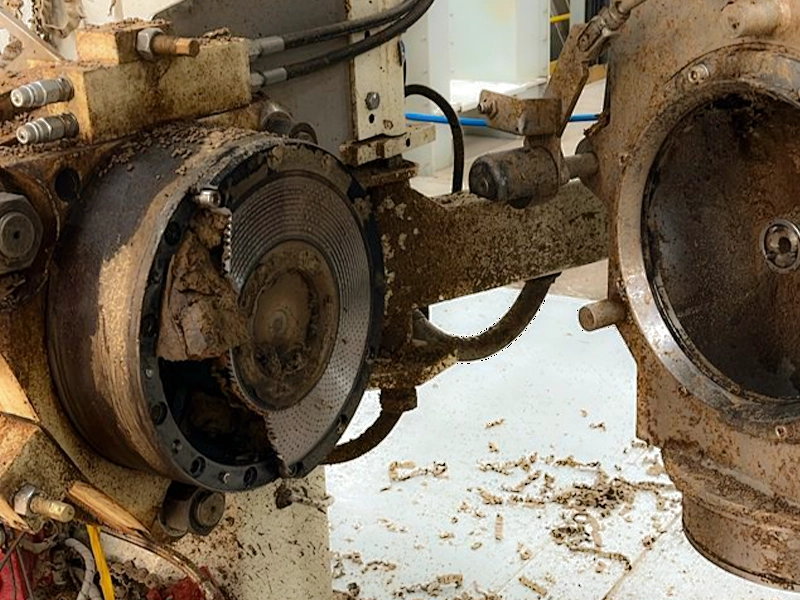
- Production Sequence: The operator changed from a 3.0mm die to a 1.2mm die immediately.
- Pulverizer Configuration: The pulverizer was using a 0.8mm mesh.
- Material Fineness: Sieve analysis showed that 95% passed through 0.5mm and 100% passed through 1.0mm.
Technical Root Causes of Die Failure
Through technical evaluation, our engineering team identified some critical errors that led to the die failure:
- Residual Materials: Residual materials for production of pellet with 3.0mm size left in the pipelines or storage tanks from the previous run act as “plugs”. When these coarse particle hit the 1.2mm die holes, they cause instant blockages, triggering a rapid rise in chamber pressure.
- Violation of the “One-Third Rule”: In extrusion technology, a fundamental rule of thumb is that the maximum particle size of the raw material must not exceed 1/3 of the die hole diameter. For a 1.2mm die, the material should be ground to 0.4mm or finer. The customer’s material contained particles up to 1.0mm. These oversize particles cause bridging at the die entrance, leading to localized pressure concentrations that exceed the mechanical limits of the steel.
Professional Recommendations for Safe Operation
Tien Phat Mechanical recommends the following rules for operation:
- Mandatory Deep Cleaning: When changing the production from large pellet sizes to small pellet sizes, a deep system cleaning is mandatory. Pipelines, conditioners, and storage tanks must be cleared of all residual coarse material to prevent immediate hole blockage.
- Descending Order Production: To protect equipment, arrange the production schedule in a descending order of sizes: 3.0mm – 2.5mm – 2.0mm – 1.5mm – 1.2mm. This allows the extruder components (screw, sleeve, and die,…) to adapt gradually to the increasing pressure gradients, minimizing mechanical stress.
- Enhance the Fineness of the Raw Materials: Apply the “One-Third Rule” to select the appropriate ultra-fine pulverizer mesh for the required feed pellet size.
- Dedicated Production Lines: For high-capacity facilities, the most efficient setup is to utilize dedicated lines – one specifically for large pellets and another for micro-pellets. This setup minimizes downtime, reduces the risk of error during changeovers, and ensures consistent product quality.
Monitoring Load Paramaters (Amperage)
Operators must closely monitor the Amparage on the control panel during start-up with small dies. A sudden increase in curent (typically >10% of normal load) is a primary warning sign of material clogging. In such cases, feeding speed must be reduced or the pressure relief valve opened immediately to prevent a die breakage.
Conclusion
Extrusion die failure is entirely preventable if we understand the causes and properly control operating conditions. At Tien Phat Mechanical, we don’t just provide spare parts; we provide the engineering expertise to keep your production line running at peak efficiency. Contact us today for the optimal solution for your extrusion system.
For more details on Tien Phat Mechanical’s Extruder Dies, please refer to the following link: https://cokhitienphat.com/san-pham/khuon-may-ep-dun-extruder-die/